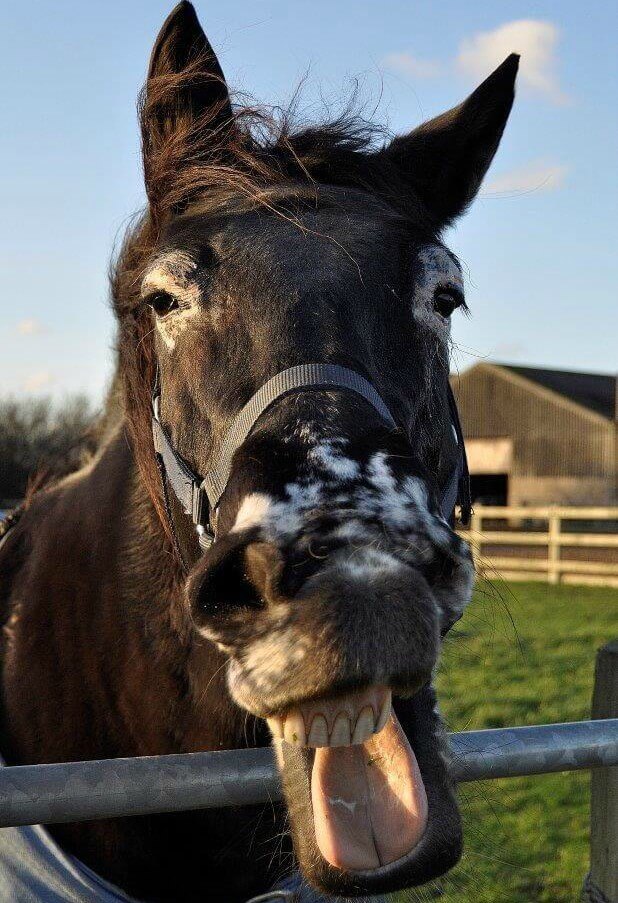
Is Your Horse Happy?
We all love our animals and want our horses to be happy – here’s five signs that can tell you if they really are!
Unfortunately when some animals come to us here at Remus Horse Sanctuary, we can see right away that they are anything but. We work tirelessly to turn things around and make sure all our residents are as content as they can be. You’ll find many stories on our website of the animals we have helped.
So how can you tell if a horse is happy?
Here are five signs to look out for…
- Body language
Watch how they behave in the field, in the stable and when you are riding. They can’t talk to us, but their body language will tell you a lot – especially if there is a marked change. - Nostrils
You can tell a lot from a horse’s nose! Unhappy nostrils are tight, thin and drawn, while a happy horse will have round, soft and relaxed nostrils. - Tail
It should hang straight, and should be quite loose, swinging freely as they move. - Mutual grooming
Do you see your horse in the field with others? If they are grooming each other, it shows they are relaxed and happy, and bonding with their ‘friends’. - A tidy bed
Happy horses keep their bedding in one place, while stressed animals might box walk or pace around their stall, kicking up their bedding.
For more details on how to tell if your horse is happy head to: www.yourhorse.co.uk/horse-care/horse-behaviour/13-signs-your-horse-is-happy.
Upcoming Events
- Sponsors Day: Sunday 23 June 2024 from 2-4pm. A special event for our sponsors only. Come and meet your sponsored animal. Please note spaces are limited and booking is essential. Please contact the Sanctuary to book on tel: 01277 356191.
- Open Day and Dog Show: Join us for our Open Day and Fun Dog Show on Sunday 7 July from 1 until 4pm. If you wish to take part in the Fun Dog Show, this starts at 1.30pm with bookings taken from 1pm. Class entry is £2 each and class information can be found on our website. Tickets for Adults £7 and for Children £5. Please book online via the Sanctuary website. Cream Teas are also available if booked in advance.
- Afternoon Tea: Monday 15 July 2pm. Included in your afternoon is a tour of the Sanctuary and an opportunity to meet some of the 200+ animals living at Remus in the beautiful Essex countryside. To book, please contact the Sanctuary on tel: 01277 356191. Tickets are £25 for a traditional Afternoon Tea and include a glass of Prosecco. Further dates 29 July and 12 August.
Keep Strangles at Bay
This time last month was Strangles week. Perhaps, with our ultra busy 24/7 lives, its something that has already fallen off your radar, but Strangles is highly infectious, and following some simple hygiene practices can stop it spreading.
Strangles is a really unpleasant disease, which can have a long recovery time, and it’s something we work hard to avoid here at the Sanctuary. Good management practices and hygiene are at the heart of keeping the disease at bay in your yard.
Should you suspect an animal has Strangles, they should be isolated immediately. This is an airborne disease so they must have a separate air space to prevent transmission should they cough or snort.
If your horse is liveried, you must also notify the yard manager and other horse owners, as animals who have had contact with an infected horse must also be isolated – even if they are not showing any symptoms.
Other safety rules to follow include keeping one set of equipment such as mucking out tools, grooming kit and feeding items etc for the isolated horse only. Keep other animals such as dogs away too, to avoid spreading infection, and dispose of waste such as bedding, feed and water in a separate area.
Humans caring for the animal should wear sturdy disposable gloves and change clothes after contact – overalls are useful here. Wash clothing and any other material items at 60 degrees to kill bacteria.
For more details about the disease itself, symptoms and treatment head to www.horseandrideruk.com/expert-advice/articles/put-stop-strangles.
Upcoming Events
- Harmony Brass Band: Harmony Brass will be celebrating the ensemble’s 40th Anniversary on Saturday 8 June by presenting a special fundraising concert in aid of Remus. The evening will include the usual eclectic and popular mix of music for all tastes and feature a selection of audience favourites enjoyed by the group’s supporters over the past 40 years. The concert will take place at Stock Village Hall from 7.30pm. If you would like to buy tickets please call 01277 622456. Tickets are £20 and you can bring your own drinks and nibbles.
- Afternoon Tea at the Sanctuary: Monday 10 June 2pm. Included in your afternoon is a tour of the Sanctuary and an opportunity to meet some of the 200+ animals living at Remus in the beautiful Essex countryside. To book, please contact the Sanctuary on tel: 01277 356191. Tickets are £25 for a traditional Afternoon Tea and include a glass of Prosecco. Further dates 15 July and 29 July.
- Open Day and Dog Show: Join us for our Open Day and Fun Dog Show on Sunday 7 July from 1 until 4pm. If you wish to take part in the Fun Dog Show, this starts at 1.30pm with bookings taken from 1pm. Class entry is £2 each and class information can be found on our website. Tickets for Adults £7 and for Children £5. Please book online via the Sanctuary website. Cream Teas are also available if booked in advance.
Essex Horse Sanctuary Invites Visitors for Open Day in June
Remus Horse Sanctuary, a leading authority in older horses, is looking forward to opening its gates and welcoming visitors to meet the 200+ animals for the first time this year, on Sunday 2 June from 1pm to 4pm. Due to the endless wet weather, Sue Burton, Founder of the Sanctuary, had to make the difficult decision not to proceed with the May Open Day.
“Visitors to the Sanctuary park on the fields and they were just too wet in May”, said Sue Burton, Founder of the Sanctuary. “We rely solely on fundraising, and missing such an important event was a devastating blow. We really need to catch a break!”
The charity has been beset by problems of late due to the extremely bad weather throughout Autumn, Winter and Spring, with a great deal of flooding and storm damage sustained, all of which hamper the important animal rescue work that the team provides and cost funds the Sanctuary just doesn’t have at present.
The Open Days at the Sanctuary are an important source of fundraising and are fun for the whole family.
In addition to the number of animals, there will be a children’s corner, roving magician and live music, plus a number of stalls selling a variety of items, a tombola and raffle. Dogs are also very welcome on a lead and parking is available on-site with disabled access.
In addition to the popular and traditional Cream Tea with two scones, cream and jam, a range of sandwiches and cakes will also be available.
Admission will be charged at just £7 per adult and £5 for children, or £15 per person to include the Cream Tea. Advance online booking is recommended via the charity’s website.
The Sanctuary organise a number of Open Days throughout the warmer months and further dates for 2024 are as follows:
- Sunday 7 July with a fun dog show
- Sunday 4 August
- Sunday 1 September with a fun dog show
- Sunday 6 October in celebration of World Animal Day
In addition to the Open Days, the charity also hosts a number of Afternoon Teas at the Sanctuary throughout the summer months and a variety of other fundraising events, Full details can be found on the Charity’s website.
Sue says, “We’re really looking forward to our June Open Day – it’s been a very wet and long winter and spring!
“We’re so immensely proud of what we achieve here, and love inviting visitors to come and meet the animals and learn more about what we do. When we can’t open due to the weather it’s such a blow to our fundraising and to our morale. Please do come and support us.”
For further information, visit www.remussanctuary.org or contact Sue Burton on tel: 01277 356191.
Our thanks to Everything Horse for sharing details of our Open Day on their website.
Harmony Brass Celebrate at the Village Hall
The popular Essex-based brass ensemble Harmony Brass are preparing for their next visit to Stock Village Hall on Saturday 8 June at 7.30pm, when they will be celebrating the ensemble’s 40th Anniversary by presenting a special concert for the occasion.
The event will include the usual eclectic and popular mix of music for all tastes, and will feature a selection of audience favourites enjoyed by the group’s supporters over the past 40 years.
Regular visitors to Harmony Brass concerts will also see popular and humorous compere, David Hurrell, seizing an extremely rare opportunity to take over the conductor’s baton for this special occasion.
To mark this important milestone, Harmony Brass have chosen to donate all of the profit from the evening to a well deserving local charity, Remus Horse Sanctuary, which celebrated its own 40th anniversary in 2023. The Sanctuary has approximately 200 animals in its care at their wonderful home at Buttsbury, and never turn away new arrivals who may be suffering from abuse, abandonment, injury or non-coping owners.
The income needed to fund this magnificent work comes solely from donations and sponsors and, after a reduction of both during COVID, income has not yet returned to pre-Covid levels. As you all know, the cost of everything has rocketed and Remus has had to deal with serious increases in veterinary costs and winter feed, as well as general running costs.
Please, if you can, come and join the fantastic and friendly Village Hall audience on the 8 June. If you have not yet been to a Harmony Brass concert, it is a great night out. The band are all happy and talented human musicians (no AI), who will do their best to ensure that you return to your homes with at least one of these same characteristics. Bring your own drinks and nibbles. Tables for up to eight are provided for club-style seating arrangements.
Tickets £20, are on sale now from: The Box Office, telephone 01277 622456.
Strangles Awareness Week 2024
Ahead of Strangles Week, two new videos have been released to raise awareness of this devastating disease demonstrating just how quickly it can take hold.
Strangles Awareness Week in the UK is an annual event taking place from 6-12 May 2024, dedicated to raising awareness about the prevention and management of Strangles, a highly contagious and debilitating respiratory disease affecting horses.
During the week, horse owners, veterinarians, and equine professionals are encouraged to come together and share knowledge, best practices, and resources to help combat the spread of the disease and protect the welfare of horses.
Take the Temp Check Challenge!
We’re encouraging as many horse owners as possible to take their horse’s resting temperature as part of their routine and enter the reading onto the free online Temp Checker where their average temperature is calculated automatically. Monitoring horses’ temperatures is a great horse health habit that makes a big difference when it comes to preventing the spread of infectious diseases.
Throughout the week, there will be practical, informative content shared across the Strangles Awareness Week social media platforms to show horse owners how to implement this into their horse care routine.
Strangles Awareness Week plays a crucial role in promoting the health and well-being of horses across the United Kingdom.
Learn more and watch the videos via this link to the original article published by Your Horse.
Follow Strangles Awareness Week on Facebook.
#SAW24 #Strangles
May Open Day:
It is with great regret that we won’t be proceeding with our first Open Day of the season on Sunday 5 May. The ongoing rain has meant that our fields where visitors park are just too wet. Instead we hope to see you at our Fundraising Fashion Show on Saturday 11 May or our June Open Day on Sunday 2 June.
Fundraising Fashion Show and Bargain Sale in aid of Remus Horse Sanctuary
Enjoy a unique afternoon of fashion at Stock Village Hall in Essex on Saturday 11 May in aid of Remus Horse Sanctuary. The fundraising fashion show will feature over 100 individual styles made up of timeless wardrobe essentials from leading high street fashion stores* such as M&S, Wallis, River Island, Mango, H&M, New Look, DKNY, Guess, White Stuff, Next, Dorothy Perkins and Oasis.
After the show guests will have opportunity to browse the rails and try on those items they’ve seen on the catwalk and purchase them at heavily discounted prices – generally at least 50% cheaper than the in-store price. A range of matching shoes and accessories will also be available to complement the clothes. And, in the event you change your mind, all items purchased can be returned within 14 days of the event for exchange or refund.
Catering for all shapes and sizes, the styles will be available in a range of sizes* from 6 – 22 ensuring there is something for everyone. During the show, the compere will describe what each model is wearing, the sizes available, and both the original and sale price.
Guests will have opportunity to win a £50 Colours Gift Voucher in the raffle, and refreshments will be available during the afternoon including tea, coffee, soft drinks, homemade cake and savoury snacks.
Doors open at 1pm for the Fashion Show to commence at 1.30pm. The fashion show itself will last approximately an hour and a half, followed by plenty of time to try on and purchase the items of choice.
Tickets cost just £6 per person, or three tickets can be purchased at the discounted price of £15. Tickets should be purchased in advance either by telephoning the Sanctuary on: 01277 356191 or via the website. Book your tickets online here for the Remus Colours Fashion Show and Pop-Up Shop.
The fundraising fashion show is being organised by ‘Colours’ a leading provider of professional fundraising events.
For further information, please contact Dee Shadforth at the Sanctuary via email: funding@remussanctuary.org.
*Subject to availability.
Enjoy the Ride!
Do you get nervous or uncomfortable riding in front of others at competitions, or even in the yard? Don’t let it spoil your fun. Instead, take some time to tackle the issues and you’ll be back to having fun, whoever’s watching!
Perhaps you worry about what others think when you’re riding, or that they’re judging you, looking for you to make a mistake or show poor performance? The reality is that they are probably not even paying you much attention and are much more focused on their own animal and riding ability.
Comparison is the thief of joy – so the saying goes – and comparing yourself to others is not healthy. For example, if you see someone at the yard who seems to be a more skillful rider than you – always remember that you are only seeing a small part of their riding life. You should remember that they may have more experience than you – it doesn’t mean you won’t reach the same level. You just need commitment and determination and a positive mindset.
Remember, at the end of the day, spending time with your horse should be fun!
For some excellent tips on fighting anxiety around horse riding, head to www.horseandrideruk.com/expert-advice/articles/sit-back-and-relax.
Look out for details of our upcoming Fashion Show! Can’t wait? Take a look at our Colours Fashion Show and Pop-Up Shop and book your tickets today.
Horse Dehydration in Winter
Looking after horses takes so much care – something the team at Remus Horse Sanctuary is well aware of! And some things that we may think of as seasonal issues aren’t actually season-specific at all.
That’s the case with dehydration – yes of course we all know to keep an eye on the animals we care for when it’s hot and sunny, but did you know dehydration can be a risk during the winter months as well?
Being in the stable more, not liking cold water or being unable to access water that has frozen can all lead to dehydration at this time of year. And that in turn can have severe consequences – a common result is impaction colic – or even death.
It’s easily avoided though. Ensure there’s always clean, fresh water available and check that troughs are not frozen. Remember that if most food is hay rather than grass, your horse will need more water than normal, as they are not absorbing any from their food intake.
You can also try adding water to feed, offer lukewarm rather than cold water and even flavour water to make it appealing – apple juice, molasses or mint are popular.
For more ideas check out this excellent Horse and Hound feature at www.yourhorse.co.uk/horse-care/vet-advice/whydehydration.
If you’ve not already done so, please consider contributing to our Winter Hay Appeal.
Make a Will Month
It’s March, and for many fundraising calendars that means one thing – Make a Will Month!
Make a Will Month is intended to encourage individuals to make or review their Will, whilst making a donation to the charity, or charities, they support.
However, it’s very expensive to sign up to the scheme and really only appropriate for much larger charities than Remus Horse Sanctuary – and for those with greater funds at their disposal. Furthermore, the recommended donation is £175, which is still a sizeable amount for an individual to find during the ongoing cost-of-living crisis. So at Remus we like to do things differently, and instead choose to promote ‘FreeWills’ which is available all year round and is, quite literally, free of charge.
What is FreeWills?
FreeWills.co.uk is an award-winning online service, where you can make a legally-binding free Will, typically in around fifteen minutes or so. Each Will is checked by legal experts and your Will can be updated quickly and easily for free, forever. It’s a free service for you and a free service for Remus. You do not need a solicitor to make a Will and, all we politely request, is that you include a donation (or legacy) in your Will for Remus Horse Sanctuary.
Visit our webpage to learn more, where we explain how FreeWills works and address the questions you might have such as:
- Is FreeWills really free of charge?
- Is a free Will, that I’ve created myself, actually legal?’
- Don’t I need a solicitor to create a Will?
FreeWills provides is a guided step-by-step process and supplies lots of information along the way, including what key terms mean, such as ‘executors’ and ‘beneficiaries’.
So why is it such a big deal to have a Will anyway? Below we look at why it makes sense to have a Will in place, regardless of age, and explain what can happen if you don’t have a Will before you die.
Why is it Important to Make a Will?
Creating a Will is a fundamental step in estate planning offering you, as individuals, the opportunity to dictate how your assets, including property, finances, personal belongings – and your beloved pets and their welfare – should be managed when you die.
Of course, we all hope that we’ll live a long and healthy life, but sadly bad things happen. It could be a simple accident with catastrophic results or sudden diagnosis of a life-threatening illness. And these things can befall us at any age.
By clearly outlining your wishes in a legally binding document, you gain control over the destiny of your estate, ensuring that it is distributed in accordance with your preferences. A well-drafted Will not only provides peace of mind but also serves to minimise the potential for family disputes and legal complexities after your passing.
It allows you to appoint executors, designate beneficiaries, and make specific bequests, offering a comprehensive strategy to protect your legacy and provide for loved ones in a manner which reflects your intentions.
It’s important to note that a Will does not have to be drafted by a solicitor in order to be legally-binding document.
What Happens if I don’t make a Will?
The absence of a Will or dying ‘intestate,’ which is the legal term, can lead to a myriad of complications. Without clear instructions, the legal process of distributing your estate upon your death becomes subject to the laws of intestacy, which may not align with your wishes. This can result in delays, increased administrative costs, and potential disputes among family members – at an already very difficult time.
Moreover, the rules of intestacy may not adequately address the needs of unmarried partners, stepchildren, friends and potentially leaving them without any inheritance. Or in the instance of your pets, leaving them without provision of care.
Without a Will, the distribution of your assets follows a predefined hierarchy, often overlooking individuals outside the immediate family. Creating a Will is, therefore, essential to avoid the uncertainties and hardships that can arise when one passes away without a clear and legally binding estate plan in the UK.
So, if you have you been putting off making your Will maybe due to time, or cost, we believe that FreeWills offers a viable alternative.
Thank you for supporting Remus Horse Sanctuary by leaving a legacy in your Will.
Remus is a registered charity founded in 1983 and FreeWills is rated 4.9 on Trust Pilot with over 4,300 reviews.
Winter Feed Donation from Dengie Horse Feeds
Dengie Horse Feeds, in collaboration with Essex Animal Feeds, has generously contributed feed to Remus Horse Sanctuary this winter. Our partnership with Dengie has flourished for over the past 15 years, during which time they have been steadfastly supporting us. Their assistance extends beyond material donations, encompassing valuable nutrition advice and thorough assessments of the horses’ diets.
This particular donation has been made at a time to support our Winter Hay Appeal.
The Dengie Hi-Fi Molasses Free and Alfa-Beet are fed to numerous horses, ponies and donkeys here at Remus, many of which have dietary-related issues such as PPID, EMS or poor dentition. The combination of high fibre feeds provides the horses and ponies with a low sugar and starch ration and can be easily eaten by those animals that struggle to chew.
The two greys pictured are Daisy on the left and Tiffany on the right, along with Minstral and the delightful little fella is Monty – he had 5 teeth out recently – they’re all busy tucking in! The Hi-Fi is a great hay replacer as none of them have good teeth (they’re in their late 30’s now) and the Alfa-Beet helps keep their weight at its optimum – and they love it!
“I have worked with the team at Remus for many years, they were actually one of the first places I visited when I joined the Dengie Nutrition team,” says Tracey Hammond, Nutritionist at Dengie. “For me, beyond helping the horses, I have found it very rewarding supplying Sue and her team with the tools to make decisions on what and how much to feed, which means it’s only the really tricky cases they need to consult me on now”.
When Dengie initially partnered with Remus, the Sanctuary homed a predominantly elderly equine population, many of whom faced dental challenges. Addressing the need for an alternative to hay that was suitable for these individuals was crucial for aiding weight gain and maintaining digestive health. Some horses participated in a Dengie-sponsored study conducted by Writtle College, examining the impact of poor dentition on forage consumption. The study revealed that horses with dental issues consumed two-thirds less food than their counterparts with healthy teeth. Introducing a fully soaked fibre source, Dengie Alfa-Beet, resulted in zero feed refusals, underscoring the importance of providing easily chewable fibre for older horses.
Over time, we saw a rise in younger horses prone to laminitis due to Equine Metabolic Syndrome (EMS). To accommodate these changes, we revamped our facilities, incorporating well-designed woodchip areas to manage horses with restricted or no access to grass.
“Our most sincere thanks to everyone at Dengie that arranged for delivery of the feed and to Essex Animal Feed for delivering it free of charge,” said Sue Burton, Founder of Remus Horse Sanctuary. “I can’t tell you how helpful that is especially whilst things are so tight. It really has made a huge difference and is so much appreciated by us all, as is all the help and support that we receive from Dengie”.
Amidst the current cost of living crisis, Remus faces heightened demands. Not only are the charity’s operational costs on the rise, but the requests for assistance with horses have also multiplied. Dengie’s contribution of Hi-Fi Molasses Free and Alfa-Beet, both widely consumed by the majority of the horses, has proven invaluable in easing this burden and we thank them for their ongoing support.
Dengie Horse Feeds is officially the UK’s favourite fibre-based horse feed, having topped the 2023 National Equestrian Survey*. The leading producer of fibre-based horse feeds using forages exclusively grown in the UK, Dengie has been growing alfalfa, one of the few ingredients grown specifically for horse nutrition, for over 50 years and continue to develop innovative and exciting feeds that promote health and performance in the horse. Alfalfa is a sustainable and environmentally friendly crop providing a natural habitat for birds, insects and other wildlife. All the crops are fully traceable from seed to feed; their non-GM status and feed management protocols set the standard in fibre feeding in the UK. Dengie offer non-biased qualified nutritional advice on feeding to horse owners and are proud to be awarded HM The Queen’s Royal Warrant.
*BETA National Equestrian Survey 2023 for fibre feed brands purchased in the last 12 months.
Click here if you would like to contribute to our Winter Hay Appeal.
Remus Drought
Other Appeal