
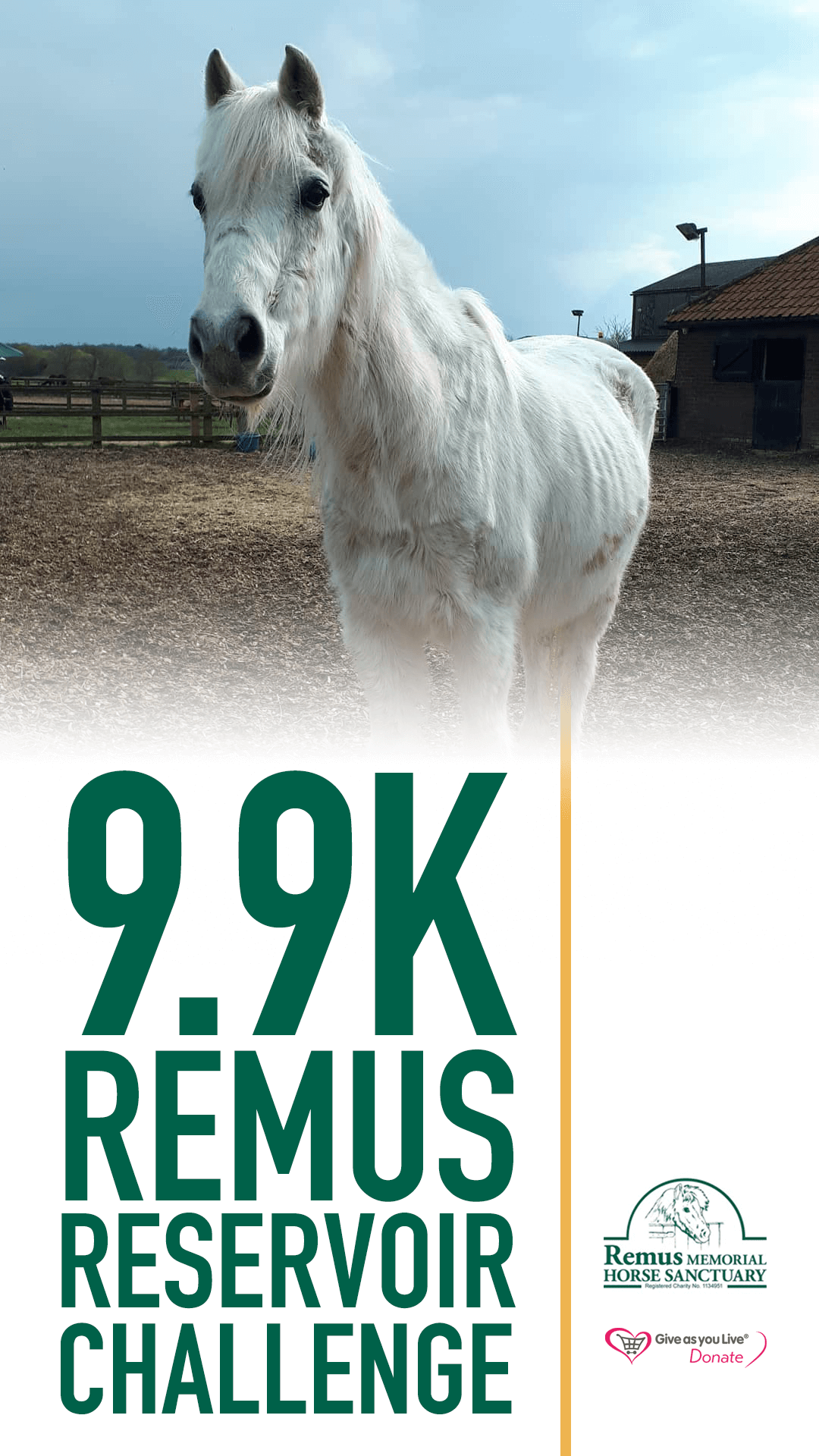
9.9K Remus Reservoir Challenge
Join us on our 9.9K Remus Reservoir Challenge! We are asking our supporters to walk, run or cycle the full distance of the Hanningfield Reservoir 9.9km, or equivalent, in a day this September or October.
Help us raise £10,000 to support the running of the Remus Horse Sanctuary, which provides lifetime help and care for horses, ponies, and donkeys, many of which are aged between 30 and 45 years old. The Sanctuary provides these equine horses a happy and pain free quality of life.
Get your family and friends involved to complete the challenge together. You can track your progress by linking your Strava account to your fundraising page.
It’s very easy! Just decide on a date to undertake the challenge, create a fundraising page and ask for donations!
Sign up today! donate.giveasyoulive.com/campaign/-remus-reservoir-challenge
#remusreservoirchallenge #remus4horsewelfare
A Family Friendly Day Out at Remus Horse Sanctuary
Remus Horse Sanctuary will be opening its gates again on Sunday 1 August for one of its summer Open Days. Unfortunately, the July date had to be cancelled last minute due to Met Office weather warnings which then never materialised. Founder Sue Burton hopes that nothing impacts their August event, especially after losing out on so much fundraising as a result of the Covid pandemic.
Sue Burton said, “As you can imagine, we really need to maximise our fundraising efforts this year to try and make up for last year’s shortfall – of course that feels like an impossible task!
“When we invite visitors to the Sanctuary for an event, we require them to park on what is normally grazing land, so it’s vital that the ground underneath is firm. Not only that but, as the majority of our events are based outdoors naturally, torrential rain and storms can affect everyone’s enjoyment as well as spooking the animals. Fingers crossed for some nice summer sunshine on August 1st!”
Members of the public are invited to visit with the animals at the Sanctuary from 1pm until 5pm on Sunday 1 August 2021. However, to minimise physical contact and maintain responsible social distancing, tickets must be pre-booked and there will be waitress service within the refreshment area.
Making an appearance at 3pm that afternoon will be none other than Mickey Mouse himself! A magician/entertainer will also be present during the afternoon to entertain the children.
Admission will be charged at £5 per adult and £2 for children and tickets can be purchased securely via the charity’s website at: www.remussanctuary.org/events/open-day-at-the-sanctuary-august or by telephone on: 01277 356191.
Parking is available on-site and disabled parking is available near to the yard. There is also a wheelchair accessible toilet. Dogs are welcome on a lead.
In line with current government guidelines, visitors will be asked to provide contact details for members in their party over the age of 16, or to scan the NHS QR Code using the NHS Covid-19 App. QR posters will be displayed at the main entrance. Contact details will not be held.
Visitors will be encouraged to wear masks in busy areas, to maintain a responsible social distance from each other and to wash their hands or use hand sanitiser regularly throughout the afternoon.
Ms Burton added, “We’ve experienced no Covid issues at our previous events. Everyone has followed the guidelines and we’ve been able to offer a great day out in the beautiful Essex countryside, and everyone has enjoyed meeting the animals while feeling very comfortable with the safety rules in place.
“Despite the relaxation in measures, we will be continuing to take the necessary precautions for the foreseeable future and we look forward to welcoming people safely.”
Further information will be available on the website at www.remussanctuary.org and the charity’s Facebook page.
Summer comes with a yellow warning
We’ve had a very typical Great British summer so far, haven’t we? A little bit of sunshine and plenty of showers! Other than not knowing whether we’re coming or going with the fluctuating temperatures – not to mention masks, social distancing and everything else we have to think about – the mix of wet and dry weather has caused everything to grow like mad, including the dreaded ragwort.
The British Horse Society recently issued a warning across the UK that ragwort levels are worryingly high due to the excess rain. Ragwort contains toxic compounds, which can cause irreversible liver damage to horses and ponies. Even more worrying, horses don’t tend to show symptoms until their liver is up to 70% damaged.
So make sure you check your fields regularly for any sign of ragwort and safely pull up and dispose of it before it spreads any further. We’re lucky enough to occupy 40 acres of Essex countryside here at Remus and love our wildlife areas, which encourage plant life and all sorts of critters, yet we still have to be ever so vigilant throughout the year to keep our fields safe for all.
Read more about the BHS ragwort warning here: www.yourhorse.co.uk/news/bhs-ragwort-warning
If you would like to make a donation to support the work we do and contribution we make to animal welfare, you can do so via our website. The link details the many different ways you can make a donation, whether online, post or telephone.
And, if you’ve not yet signed up for our latest fundraiser, here’s the link: donate.giveasyoulive.com/campaign/-remus-reservoir-challenge.
9.9K Remus Reservoir Challenge
Many charities like Remus Horse Sanctuary have been directly impacted by the coronavirus pandemic. It has massively affected the charity’s fundraising activities and they have lost out on crucial donations for horses in their care.
The charity is calling on any supporters to help them raise £10,000 in donations by taking part in their 9.9K Remus Reservoir Challenge. Supporters are encouraged to walk, run, or cycle the full distance of the Hanningfield Reservoir in a day this July and August.
Sue Burton from Remus Horse Sanctuary commented: “Our mission is to bring an end to horse cruelty by helping the horse welfare operation in the UK. The animals are our prime concern and are treated with the utmost respect. Our aim is to rescue and rehabilitate the animals to give them every chance to thrive into old age.
“However, this is something we cannot achieve on our own and heavily rely on fundraising events so that supporters can help us raise much needed donations.”
All donations raised will go towards the running of Remus Horse Sanctuary, which provides lifetime help and care for horses, ponies, and donkeys, many of which are aged between 30 and 45 years old. The Sanctuary’s mission is to provide these vulnerable animals with a happy and pain-free quality of life.
Further details of the 9.9K Remus Reservoir Challenge can be found at www.remussanctuary.org or sign up today at: donate.giveasyoulive.com/campaign/-remus-reservoir-challenge.
#remusreservoirchallenge #remus4horsewelfare
Return of Fun Dog Show to Charity Open Day
Remus Horse Sanctuary is delighted to announce the return of its Fun Dog Show to its popular Open Day this July. Previously on hold due to the Covid restrictions and despite the delay of step four of the Lockdown Roadmap, the Charity will be able to incorporate the fun dog show and children’s entertainer, including an appearance by Mickey Mouse at 3pm!
Members of the public are invited to join the team and animals at Remus when it opens its gates at 1pm on Sunday 4 July 2021. However, to minimise physical contact and maintain social distancing, tickets must be pre-booked and there will be waitress service within the refreshment area.
Admission will be charged at £5 per adult and £2 for children. Tickets can be purchased securely online at: www.remussanctuary.org/events/open-day-at-the-sanctuary-july, or via the telephone on: 01277 356191. The Fun Dog Show will commence at 2pm, entrants must pre-pre-book and arrive no later than 1.30pm. Entry costs £2 per class. A list of the classes can be found on the charity website.
Parking is available on-site and disabled parking is available near to the yard. There is also a wheelchair accessible toilet. Dogs are welcome on a lead.
Sue Burton, founder of the Sanctuary said, “We are absolutely delighted to be able to incorporate our fun dog show into our July Open Day! That said, we will be continuing to take a cautious approach with limited numbers and asking visitors to maintain social distancing. We still want our visitors and the Remus team to feel safe and to be safe.”
In line with current government guidelines, visitors will be asked to provide contact details for members in their party over the age of 16, or to scan the NHS QR Code using the NHS Covid-19 App. QR posters will be displayed at the main entrance. Contact details will be held for 21 days to assist the government’s Track & Trace system.
Visitors will be asked to keep two metres apart from others and encouraged to wash their hands or use hand sanitiser regularly throughout the afternoon.
Ms Burton added, “We experienced no problems at our May and June events and everyone who came along had a great time out in the open in the beautiful Essex countryside and enjoyed meeting the animals while feeling Covid safe. We sincerely hope that our stringent measures will mean we can continue to open safely throughout the summer.”
Further information on the fun dog show will be available on the website at www.remussanctuary.org and the charity’s Facebook page.
Laminitis: the silent monster in older horses
We’re finally enjoying some much warmer weather but, as usual for horse owners, it comes with additional challenges! Many vets up and down the country have reported rises in cases of Laminitis, with the mixture of the warm and wet weather making the grass grow like crazy.
Many of our residents here at Remus are elderly and Laminitis is just one of the conditions that we are very careful to monitor all year round. While late teens used to be considered old for a horse, many now live and often work well into their twenties and longer.
And now, a new study has found that horses over the age of 25 may be suffering from chronic Laminitis but not showing any of the obvious signs.
The research has come out of the Swiss Institute of Equine Medicine. They looked at 51 clinically sound horses between the ages of 15 and 32, so what we would consider ‘veterans’.
They x-rayed their feet to check for pedal bone rotation and also assessed their body condition scores (BCS), cresty neck scores (CNS) and levels of adrenocorticotropic hormone (ATCH), which can be a sign of Cushing’s, another condition often found in older horses that can lead to Laminitis.
Almost half of the horses’ x-rays showed signs of pedal bone rotation, but none showed signs of acute lameness or Cushing’s, which goes to show that our horses could be suffering in ways we don’t expect so monitoring and awareness are key.
Read more about this in Horse & Hound.
You might also like to take a look at our feature in Horse Magazine on how we eradicated Laminitis from the Sanctuary.
You can also visit our website to learn more about elderly horse care.
Giving Checkout – A New Online Tool by JustGiving
In the past year, more and more people have been going digital and JustGiving is addressing this by helping charities and supporters get a smoother user journey through its new online donation tool called Giving Checkout.
Why is this important to us?
Put quite simply, it’s a no-brainer! Giving Checkout is completely free to use for your direct donations (including regular gifts), so every donation makes an even bigger impact for us. Plus there’s no platform fees on JustGiving and, for Giving Checkout donations, they’ll cover the processing fee from a donor’s voluntary contribution if you do “tip” or absorb the cost if you don’t. Plus, donations can be made in five currencies via all major credit and debit cards, PayPal, Apple Pay, Google Pay and Pay with Bank Transfer. As an HMRC approved Gift agent JustGiving can boost all eligible donations by 25% (though a 5% fee does apply for this service).
What to do next?
If you see a JustGiving ‘Donate Now’ button, please click it!

Thanking you, as always!
Celebrating Volunteers Week 2021
This week we’re celebrating the difference volunteers make to our charity and thanking them for all their time and dedication during this year’s Volunteers’ Week, which runs from 1-7 June. Furthermore, this 37th annual Volunteers’ Week is taking place during #MonthOfCommunity!
Volunteers don’t get paid.
Not because they are worthless.
Because they are priceless!
We would like to take this opportunity to thank each and every one of our volunteers for all their hard work and generosity.
Meet Esme who was announced as Horse & Hound Volunteer of the Year 2020!
Did you know?
- 4 million people volunteered through a group, club or organisation during 2018/19.
- More than half of the population gets involved in informal ways of volunteering.
- Most people have formally volunteered at some point in their lives, dipping in and out of involvement over time.
- Volunteers get involved in different ways, reflecting their lifestyles, values and priorities.
- A small proportion of volunteering takes place via employers, mostly in large organisations.
Like many charities we have suffered tremendously as a result of the pandemic, not just financially, but because our volunteers were not able to visit and help us. At an animal sanctuary, work goes on as normal whatever the situation as the animals still need feeding, caring for, exercising and more.
There are lots and lots of ways you can help us here at the Sanctuary and please do check out our two web pages on both volunteering and microvolunteering. We love to welcome teams from businesses too, a day at a working yard is great for team building! Hopefully it won’t be long before we can welcome everyone back to the Sanctuary without needing to observe social distancing etc.
If you’d like to visit the Sanctuary, view our events page on the website.
#VolunteersWeek and #MonthOfCommunity
Visitors invited to Covid-Safe Open Day at Essex Horse Charity
Remus Horse Sanctuary will be opening its gates on Sunday 6 June 2021 to welcome visitors safely to the charity with numerous Covid-safe measures in place. To minimise physical contact, tickets must be pre-booked, entry times will be staggered, and there will be waitress service within the refreshment area.
The Sanctuary will be open from 1pm to 5pm for the event and pre-booking is essential either via the website or telephone as the charity will only be selling a limited number of tickets to ensure everyone’s safety and maintain social distancing.
Admission will be charged at £5 per adult and £2 for children. Tickets can be purchased securely online or via the telephone on: 01277 356191.
Parking is available on-site and disabled parking is available near to the yard. There is also a wheelchair accessible toilet. Dogs are welcome on a lead.
Sue Burton, founder of the Sanctuary said, “We are taking a cautious approach to our events this year. We want our visitors and the Remus team to feel safe and to be safe.
“Our on-site events are generally outdoors anyway, but we have put in place a number of measures to keep interaction to the minimum. For example, there will be stalls, but no stalls that allow for interaction, such as our regular tombola or children’s corner. We’ll even be disinfecting the fencing!”
In line with current government guidelines, visitors will be asked to provide contact details for members in their party over the age of 16, or to scan the NHS QR Code using the NHS Covid-19 App. QR posters will be displayed at the main entrance. Contact details will be held for 21 days to assist the government’s Track & Trace system.
Visitors will be asked to keep two metres apart from others and encouraged to wash their hands or use hand sanitiser regularly throughout the afternoon.
Ms Burton added, “We experienced no problems at our Open Day earlier in May. Everyone came along and had a great time out in the open in the beautiful Essex countryside and enjoyed meeting the animals whilst feeling Covid safe. We hope that our stringent measures will mean we can continue to open safely throughout the summer.”
For further information, visit www.remussanctuary.org or contact Sue Burton on tel: 01277 356191.
No more stigma for strangles
This week (3-9 May) is Strangles Awareness Week. Many of us will know about strangles and the devastating effect this highly contagious disease can have on our equine friends and the wider industry. It does also sadly still carry a stigma, which the British Horse Society (BHS) want to challenge and get people talking about.
There are over 600 outbreaks of strangles in the UK each year. It’s spread through contact with a bacteria called Streptococcus equi, so can quickly infect horses and whole yards, resulting in lockdowns and cancellation of events to stop cases from multiplying.
Here at Remus, our four Shetlands came to us in extremely poor condition and suffering from strangles. Archie, Oscar, Dusty and Drifter were less than a year old at the time and were being dragged around the country from market to market, before finally being saved from slaughter.
This week hopes to educate everyone on how with relatively simple steps and good biosecurity could play their part in losing the stigma and eradicating the disease for good.
Join in the discussion: www.bhs.org.uk/our-charity/press-centre/news/2021/april/strangles-awareness-week.
You are welcome to come and meet Archie, Oscar, Dusty and Drifter and all of our other animals at our next Open Day on Sunday 6 June from 1pm to 5pm. Pre-booking is required as we are only able to sell a limited number of tickets at present. Find out more on our website and pre-book your tickets today!
Remus Drought

Other Appeal