


Make your Will for FREE
Leaving a legacy in your Will is one of the best ways of ensuring that we can continue our valuable work. As you know, we rescue horses, ponies, donkeys and more, and provide rehabilitation and respite to them and to elderly horses, and all of our work is paid for by donations and fundraising. A gift in your Will, however small or large, can help ensure we can always be here for those victims of physical and mental abuse, whether it be as a result of ignorance or malicious intent.
By making a Will you can ensure that your wishes, and the people and causes you care about, are provided for. After providing for your family and friends remembering us in your Will means that we will be able to carry on the vital work of rescue, lobbying and education. By leaving a gift to Remus Horse Sanctuary in your Will you can shape the future, ensuring that we are always here to raise a voice for animal welfare.
Remus Horse Sanctuary is committed to being there for those animals that need us – after all, they cannot speak for themselves. If you decide to leave a gift in your Will to us, you will be supporting us to make sure we continue our valuable work with animal rescue and welfare.
Every single gift is vital to Remus and we appreciate any gift you may choose to leave us. Whatever the value of your gift, it will go a long way to help an animal that needs us.
It will not cost you a penny during your lifetime. It is simple to do and is free from inheritance tax.
All gifts, whatever their size make a real difference. It truly is a gift of a lifetime.
We thank you in advance for making a generous and thoughtful contribution.
Your gift will make a lasting and positive difference to Remus Horse Sanctuary.
Click here to find out more> www.freewills.co.uk/charity/remus-sanctuary
The New Highway Code: How it Affects You and Your Horse
You might remember back in January we mentioned a review of the Highway Code. As of 29 January 2022, a number of changes to the code came into force – and it’s one step closer to making our roads safer for horses and riders. Most significantly, a new hierarchy of road users means that riders are to be considered equal to cyclists.
So what does that mean in practice? We’ve broken down some of the most important things you need to know.
- The new hierarchy of road users gives more responsibility to those who present the most risk. For example – drivers have responsibility for themselves, as well as cyclists, horse riders and pedestrians, because they present the most risk.
- Within the hierarchy, cyclist and horses riders are to be treated equally.
- Riders have responsibility for themselves, and more vulnerable road users like pedestrians.
- Other road users must pass riders at no more than 10mph, with at least 2 metres of space.
- Cyclists must not pass a horse on the left.
- Drivers should take extra care when entering a roundabout, and must not cut across riders who are continuing around the roundabout in the left hand lane.
- Horse riders should give way to pedestrians on a zebra crossing, and pedestrians and cyclists at a parallel crossing.
- Horse riders should give way to pedestrians on bridleways, or other shared use paths.
All of the above changes have been welcomed by the British Horse Society, who have been campaigning tirelessly to make the roads safer for horses and riders.
With almost 2 horses killed each week on UK roads, and that number increasing year-on-year, the new rules are aimed to protect horses and riders as vulnerable users.
You can read more about the Highway Code changes here.
As you may know, Storm Eunice raged through the Sanctuary, tearing apart field shelters, flattening fences and ripping into roofs. Please help us to rebuild.
Goats saved from slaughter with new home at Remus Horse Sanctuary
Remus Horse Sanctuary has literally provided sanctuary for Arnie, Patch, Bobby and Bonnie, by saving them from slaughter! The young goats, all about a year and a half old, were originally born and bred for meat but, thankfully, their owners couldn’t face it when the time came.
Arnie and Patch, the bigger of the four, are Boer goats which were originally bred for the meat industry due to their fast growth rate and good meat quality. However, the breed actually originates from South Africa where they were kept by tribespeople for land management. The smaller pair – Bobby and Bonnie – are both a Boer/Pygmy cross, hence their smaller size. They are all quite naughty and playful which is another trait of the breed.
The original owners, from a smallholding in Essex, came to love the animals whilst in their care and couldn’t face sending them to slaughter when the time came.
The goats have spent a period of time in isolation before being integrated with Remus’ existing goat herd.
Sue Burton, Founder of Remus Horse Sanctuary, explained: “We were approached by our Farm Vet to see if we could offer these little goats a home. How could we say no – they’re just delightful little characters and we couldn’t possibly see them go to slaughter!
“Thankfully they integrated well with our existing herd and immediately made themselves at home! We look forward to introducing them to visitors at our first Open Day in May.”
To sponsor Arnie, Patch, Bobby or Bonnie or to find out further information about the invaluable work at the Sanctuary, visit www.remussanctuary.org or contact Sue Burton on tel: 01277 356191.
10 Amazing Facts About Horses
- The original horse was no larger than a Jack Russell. Known as Hyracotherium or Eohippus; it looked more like a deer than the modern day horse! Hyracotherium lived about 50 million years ago and was a forest dweller. In contrast to the horses of today it had four padded toes on the front legs and three padded toes on the back legs.
- Horses have the largest eyes of any other land mammal.
- An adult horse’s brain weights 22 ounces, about half that of a human.
- Horses can’t vomit due to them having a strong band of muscle around their oesophagus, known as the Cardiac Sphincter. Other animals that can’t vomit include rabbits, guinea pigs, frogs and rats.
- The world’s smallest horse breed is the Falabella which ranges from 38-76 cm tall!
- Horses cannot breathe through their mouth, only through their nose!
- Equinophobia is the fear of horses.
- When foals are born their hooves are covered with a soft tissue. This prevents damage to the mare’s birth canal and uterus. This tissue has several names such as fairy slippers or golden hooves.
- Just like humans, some horses are quite sensitive to the sun and can get sunburned on the non-pigmented pink areas of the skin. Common areas of sunburn include around the eyes and muzzle, especially on horses that are light coloured, such as greys.
- The oldest ever recorded horse was ‘Old Billy’, who is said to have reached the age of 62! He was born in Lancashire in 1760. Old Billy died on November 27th 1822 near Manchester.
Remus Pledges to Tackle Fraud
Fraud is an ever-evolving and increasing criminal threat to society. No organisation – charitable or otherwise – can make itself completely immune to fraud but it can take steps to minimise the risks. Remus Memorial Horse Sanctuary is committed to doing precisely that, which is why we have signed the Fraud Pledge: www.preventcharityfraud.org.uk
Benefits of signing the Fraud Pledge
By taking the pledge we are showing that we work actively to prevent fraud, wherever it might occur in our organisation. We are now entitled to use the Fraud Pledge badge on our website, newsletters and printed materials. It will help us build trust among donors, funders and beneficiaries by providing us with a visible demonstration that we take the protection of our assets very seriously.
You, Your Horse and Your Mental Wellbeing
The last two years have been hard – and we’re not talking about Remus’ financial hardships as a result of the lack of fundraising – the Covid-19 pandemic has bulldozed its way through our lives, challenging each and every one of us.
But in the wake of that incredibly difficult time, and hopefully as we head into a new era of normality, there seems to be a positive mental shift occurring; a newfound sense of appreciation amongst us. Some people have prioritised their health and chosen more active lifestyles. Others have resigned from jobs that left them feeling uninspired or opened a business out of their passion project. There are new hobbies, new relationships, new banana bread recipes! People are thinking about their own happiness, and their own mental wellbeing. So how do our horses play a part in that?
It is a well-trodden research path, the link between mental health and our relationships with animals. There is vast amounts of evidence to show that our furry friends can reduce stress levels, and help treat anxiety and depression. Horses provide us with companionship, help us build trust, and increase our mental focus. Not to mention the benefits of exercise and fresh air from riding and being outdoors.
In a recent Horse & Rider article, Emma Hutchison explores this link in more detail. She asks the question, What lessons can we learn from our horses?
We all know the saying, ‘Treat others as you wish to be treated’, but how about ‘Treat yourself as you’d treat your horse’? In the article, Emma talks about the levels of compassion we offer our horses on a daily basis. The good practice of working with “the horse you have on the day”, and treating each day differently, according to their moods and needs. Can you honestly say you offer yourself the same opportunity? Checking in on how you’re feeling each day is an important part of mental wellbeing. It helps you treat yourself with kindness and show compassion for yourself on an ‘off-day’.
There are a lot of things we can learn from our horses. This article shines a light on how mental wellbeing can be one of them. You can read more here.
Find out how Storm Eunice wreaked havoc at the Sanctuary.
Images: Sophie Boeme
Storm Eunice Wreaks Havoc at Elderly Horse Sanctuary
Storm Eunice raged through the Sanctuary on Friday 18 February 2022, tearing apart field shelters and flipping them into the air like cardboard, flattening fences and ripping tiles from roofs. Please help Remus rebuild and make the necessary repairs and replacements.
Field Shelters cannot be covered by insurance and, due to the rising cost of timber and inflation, Ms Burton is estimating a total of £34,500 will be required to address the full list of repairs resulting in the wake of Storm Eunice.
Initial investigations have reported a lengthy list of repairs at the Sanctuary amounting to tens of thousands of pounds. Major repairs are required as follows:
- Five field shelters destroyed
- Roof tiles missing from Donkey shed and across the yard
- Skylights in roofs blown out
- Apex and other bits of roofs broken
- Fencing smashed to ground
Founder of the charity, Sue Burton said, “We have never seen such devastation in such a short period of time – five field shelters were shattered, fences were flattened and tiles were ripped from roofs.
“As a charity we’re still reeling from the pandemic and losing out on all that fundraising for such a long period of time, so for something like this to happen now… well it’s beyond words!”
To help rebuild Remus please donate via their JustGiving page at www.justgiving.com/campaign/rebuild-remus-after-eunice.
For further information about the invaluable work at the Sanctuary, visit www.remussanctuary.org or contact Sue Burton on tel: 01277 356191.
Turn points into positivity
Your Nectar points could help make a real difference to charities like ours.
We’ve partnered with Nectar Donate, a new scheme which allows you to donate some (or all) of your Nectar points to good causes and charities on Crowdfunder!
No matter how many Nectar points you choose to donate, each and every one will be supporting your chosen charity, helping to make a real difference to our cause. It’s quick and easy to donate and there are no hidden fees!
How it works
- Click ‘Get started’ to find a charity you’d like to support and click donate
- When on the checkout page, ensure you sign in or sign up to your Crowdfunder account
- Select ‘Donate with Nectar’ at checkout and ensure your Nectar account is linked – you’ll only need to link once
- That’s it! Your Nectar points will then become pounds sent to support your chosen charity
Every 200 points = £1 donated
100% of your donation will help do good for your chosen cause as there are no hidden fees.
Donations will need to be made in increments of £1 (200 points).
Storm Eunice wreaked havoc at the Sanctuary last week, find out more here.
Family of Elderly Shetland Ponies Rehomed
Damson, April and Mopsey find sanctuary at the horse charity in Buttsbury, near Ingatestone in Essex.
Three elderly Shetland Ponies, all in their thirties, have been rehomed at Remus Horse Sanctuary after their owner was struggling to look after them. Damson (38 years old), mother of April (32 years old) and aunt to Mopsey (36 years old) will be loved and cared for at the Sanctuary and receive the required medication to manage their various ailments.
At present the girls are in isolation whilst tests are being carried out to ascertain their needs – elderly horse care is a specialty at the Sanctuary. As horses and ponies get older it is vital owners are aware of their changing needs – in particular their teeth, diet, stabling and general healthcare.
The picture shows these delightful little girls from left to right: Damson, mother of foal April, and her niece Mopsey. Damson suffers from Cushings’ disease (PPID), which she is being treated for, and Laminitis. Due to her thick Cushingoid coat she has been clipped.
The previous owner, an elderly lady who was struggling to look after the ponies and her own sickly mother at the same time, contacted founder Sue Burton to see if the charity could help.
“It broke her heart to part with them, but she had the strength to make the right decision by them and let them come to Remus,” said Sue.
Extensive blood tests are required on all new animals at the Sanctuary. They have had their first Strangles test which came back clear. Once the second test is completed and they have the all-clear, they will be able to go out into the paddocks, meet the other ponies and live the rest of their lives together.
“Damson, April and Mopsey are such delightful little girls! They’ve always been together and, by coming to Remus, we will ensure they stay together.
“At the moment, this is quite a change for them, and Damson is quiet and quite nervous. April the youngest and by far the spriteliest has a lot of character and is the most confident. Mopsey is quiet and timid, she’s still not sure of us.
‘All three love their food and are eating well, which is always a good sign. We’re really looking forward to seeing how they develop and settle in at Remus.”
Anyone wishing to make a donation to support the ongoing care of Damson, April and Mopsey at the Sanctuary can do so online or direct to the charity. Details can be found at: www.remussanctuary.org/donate. People can also find out about sponsoring the newly homed Shetland Ponies here: www.remussanctuary.org/how-you-can-help/sponsor.
For further information, visit www.remussanctuary.org or contact Sue Burton on tel: 01277 356191.
Hold your Horses, Drivers
The keen reader might remember that in last month’s blog we talked about the benefits of reporting incidents on the BHS Horse i app. The data collected by the app supports both local and national campaigns for equine safety – in particular their Dead Slow safety campaign.
We are currently seeing too many reports of road traffic incidents involving horses, so this is particularly relevant right now.
Launched in 2016, Dead Slow looks at ways to improve both horse and rider safety on the road. It provides education to drivers on how to pass horses safely, encourages riders to take measures to protect themselves, and works with MP’s, the police and road safety partnerships to drive community awareness and improvements.
Last year the Government undertook a review of the Highway Code. With the support of Dead Slow and the data gathered through Horse i, the BHS have been heavily involved as a member of the Highway Code stakeholders focus group. Acting as a voice for the horse community, the BHS suggested some significant amendments to the code. These amendments were laid before parliament in December and, we are pleased to report, due to be implemented by the end of January!
BHS Director of Safety Alan Hiscox told Horse & Hound of the changes, “I was dancing a little jig when I read them!” Adding, “this will be a major step for the safety of horses on the road.”
Some of the most significant changes are:
- Drivers are advised to pass horse riders and horse-drawn carriages at 10mph or less
- Drivers are advised to give riders at least two metre’s space when passing
- Riders will be considered alongside cyclists in a new hierarchy of road users
- Clarification that horses should never be passed on the inside
- Feral or semi-feral ponies require the same consideration as ridden horses
You can read more about the upcoming changes to the Highway Code, and Mr Hiscox’s response in this article of Horse & Hound.
The horse welfare crisis in this country continues to escalate and, on the back of the pandemic, Remus continues to exist literally from one day to the next. To make a donation please visit our appeal at: www.justgiving.com/campaigns/charity/rmhs/cryforhelp.
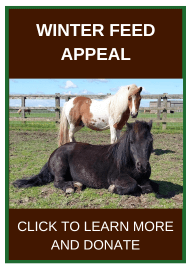
Winter Feed Appeal
Other Appeal